
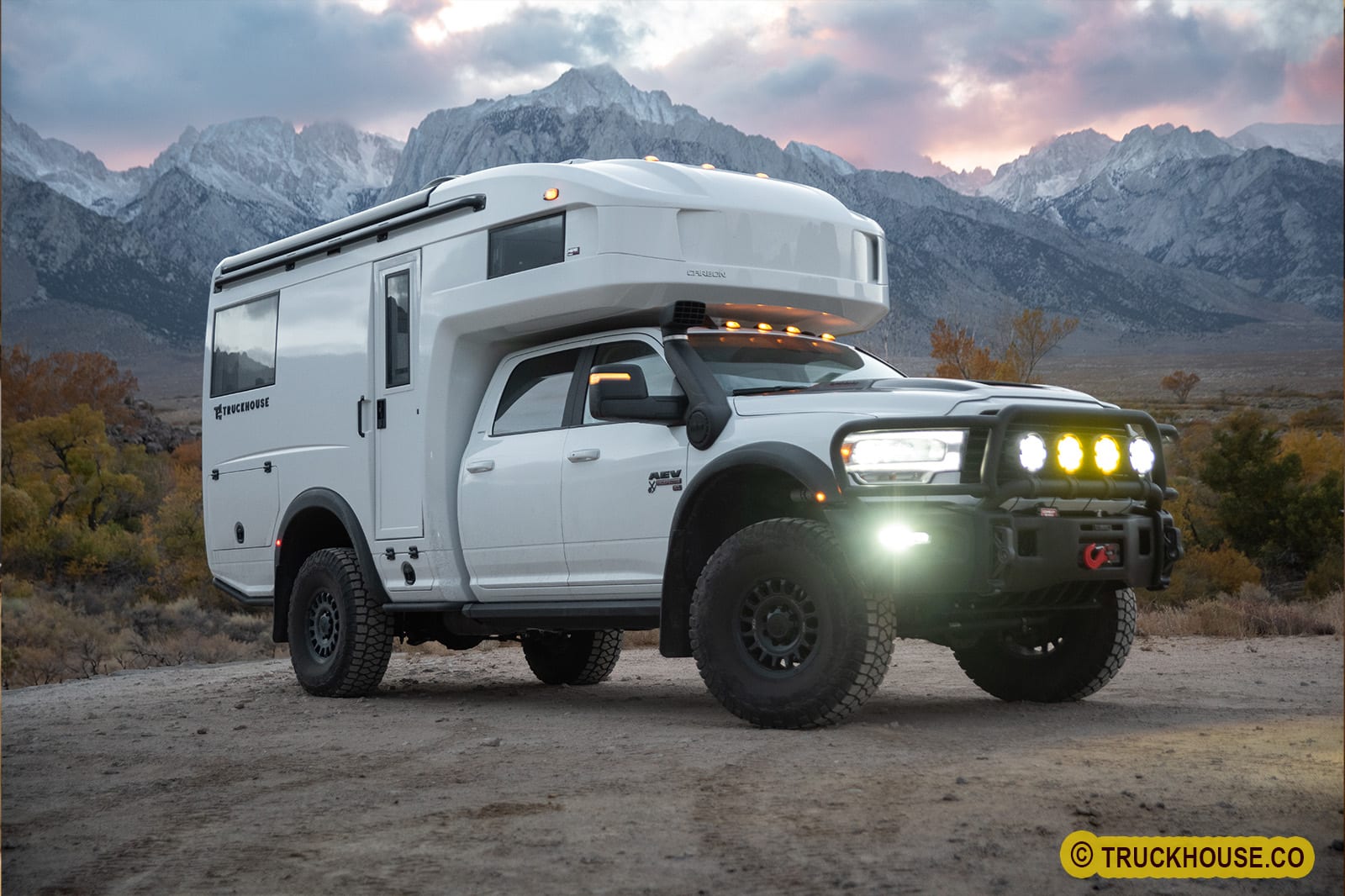
The TruckHouse BCR is a truck camper built on a Ram 3500 chassis upfitted by AEV into an AEV Prospector XL. Matt Linder, CEO of TruckHouse, walks through the interior in this official walkthrough, and there’s enough going on inside this thing to make it worth a close look.
Vehicle Platform
The base is a Ram 3500 cab chassis upfitted by AEV into a Prospector XL. TruckHouse builds on both two-door and four-door configurations and can go up to a 5500 chassis for customers who need to tow serious equipment alongside the camper. The truck shown here is a Ram Limited, the highest trim level, but TruckHouse says they can build on a Tradesman as well.
Suspension is AEV’s dual sport system, which uses factory geometry for steering and suspension along with a lot of factory components. There’s no aftermarket suspension control panel in the cab because the system doesn’t need one. According to Linder, a lot of aftermarket suspension setups on vehicles like this can’t be serviced by a local dealer, and the AEV system doesn’t have that problem. It’s fully serviceable and there’s no failure mode that leaves you stranded.
AMP power steps are fitted to the Ram cab chassis. The factory Ram auxiliary switches are retained and some are wired into 7000 series AEV lights mounted on the bumper. Spare switched circuits are available for future accessories.
Under the passenger seat sits an integrated ARB onboard air system for airing up tires after off-road runs, winterizing the plumbing, or blowing dust off gear.
Cab and Pass-Through
All factory Ram features remain fully functional, including radar-guided cruise control, lane keep assist, the digital rearview mirror, backup camera, and heated and cooled seats. The factory warranty carries over intact.
The rear seat area offers a few configurations. The build shown has two captain’s chairs, but customers can keep the full factory bench, delete one section for 60% storage, or do a full seat delete with a complete Goose Gear storage setup. A carbon fiber pass-through connects the cab to the camper, with embroidered TruckHouse headrests on the rear seats framing it.
Cabinetry and Interior Construction
The cabinets are molded fiberglass built in-house using a vacuum infusion process. They’re waterproof and won’t warp, twist, crack, or swell from off-road abuse or climate changes. TruckHouse intentionally avoided a shiny gel coat finish to keep the interior from feeling clinical. The paint sheen is dialed back, and hand-sawn wood veneer is applied over composite panels throughout, keeping weight down while bringing real wood warmth into the space.
Hardware throughout uses locking push-button knobs and stainless steel drawer boxes, all soft-close. Every drawer and cabinet stays latched while off-road.
Sleeping
The king-size bed sits at the rear upper section of the camper. Getting up there is a carbon fiber ladder built in-house that weighs about three pounds and clips onto a carbon fiber rail at any position along its length. TruckHouse maximized the mattress-to-roof height and kept the overall vehicle height low by skipping a stair system under the mattress.
The bed works north-south or east-west, so getting up in the middle of the night doesn’t require climbing over anyone. A light switch at the bed controls the toe kick lights only, so you can navigate without waking a partner. Each side of the bed has a reading light, a speaker, an outlet, and a cubby sized for a water bottle, phone, or book.
A large skylight and two side windows, all with integrated bug screens and blackout shades, bring in fresh air and natural light. There are no front windows on the camper, and that was intentional. It made for a more aerodynamic shell, front windows are prone to breaking, and it gave the bed a solid headboard instead of a screen or blind to rest pillows against. A 32-inch TV with Apple TV connected to Starlink mounts up front and pivots 180 degrees to face the rear dinette as well.
Control System
A Garmin touchscreen is mounted just above the entry door and handles lights, the inverter, solar, the Fusion sound system, remote gray water dump, heating, heated floors, water tank freeze protection, and the autogen. It can also be controlled from a phone.
Entry and Galley
The entry door has an integrated window, three-point locking, a stainless gas strut to prevent wind slamming, and solid insulation. The entry floor sits lower than the rest of the camper floor intentionally, acting as a drain basin. Muddy shoes, wet snow gear, and dog paws can all be cleaned there and drain outside without tracking mess through the camper.
The galley runs a two-burner induction cooktop and a deep stainless steel sink big enough for pots and pans. The countertop is Richlite, a material from residential construction that was light enough to use in a vehicle application. Stone was ruled out because of weight. There’s no window behind the galley, which Linder is direct about: a roller blind next to an active cooktop is a problem nobody wants to solve, and the clean backsplash is easy to wipe down.
Below the cooktop is a 24-inch Bosch speed oven that functions as a microwave, convection oven, and broiler, among other modes. It opens like a conventional oven rather than a microwave door, which was a deliberate choice. Under the sink there’s a pull-out trash bin and a pull-out pantry.
Across from the galley is a drawer-style stainless steel refrigerator. Cold air stays in the drawer when it’s opened rather than spilling out onto the floor the way it does with a front-opening fridge, and nothing falls out at you after a day of off-roading. The drawers can be configured as fridge-fridge, fridge-freezer, or freezer-freezer.
Above the fridge, a wide oak bifold door opens to what TruckHouse calls the coffee bar, with two stainless steel shelves with hemmed edges. The shelves are fully modular and can be repositioned or removed entirely to fit an espresso machine or blender, or to use the space as a standing desk. Power is available inside. Next to that is a hanging closet with marine-grade CNC-cut flooring on the bottom to keep items from sliding while traveling. All cabinets share that same flooring treatment. Below the closet, integrated flip-down shelves let you configure for larger or smaller items.
Rear Dinette
The rear dinette wraps 270 degrees of windows, all crystal clear, with integrated screens and blinds, and they open safari style. The U-shaped seating converts to a full-size bed without any accessory fill panels. The table drops down to fill the void and the strut stays attached. The table also pivots for easy entry and exit from either side, and slides closer to the user for laptop work or meals.
The cushions have a 3-degree bevel on the seat and a 7-degree rake on the back, based on human physiology data, for a more comfortable seating position. Flipping the cushions over gives a flat sleeping surface for the bed conversion.
Outlets on both sides of the dinette have 12-volt and 120-volt power. A flush-mounted LED under-cabinet light handles ambient lighting, and Fusion sound system speakers are integrated overhead with a subwoofer in the bench bottom. Standing height in the dinette is over six feet five inches, and the headliner is upholstered for sound deadening and a softer feel.
Wet Bath
The wet bath is a full wet bath with three toilet options available: dry flush, composting, or cassette. The bathroom is independently heated, so it doubles as a gear drying room. A full-length mirror is mounted on the back of the door.
Final Thoughts
TruckHouse is clearly putting a lot of attention into material choices and construction details that most camper builders don’t bother with, from vacuum-infused fiberglass cabinetry to a three-pound carbon fiber ladder. The electrical system, HVAC, and plumbing specs are covered in separate videos, so there’s more to this build than what’s shown here.