
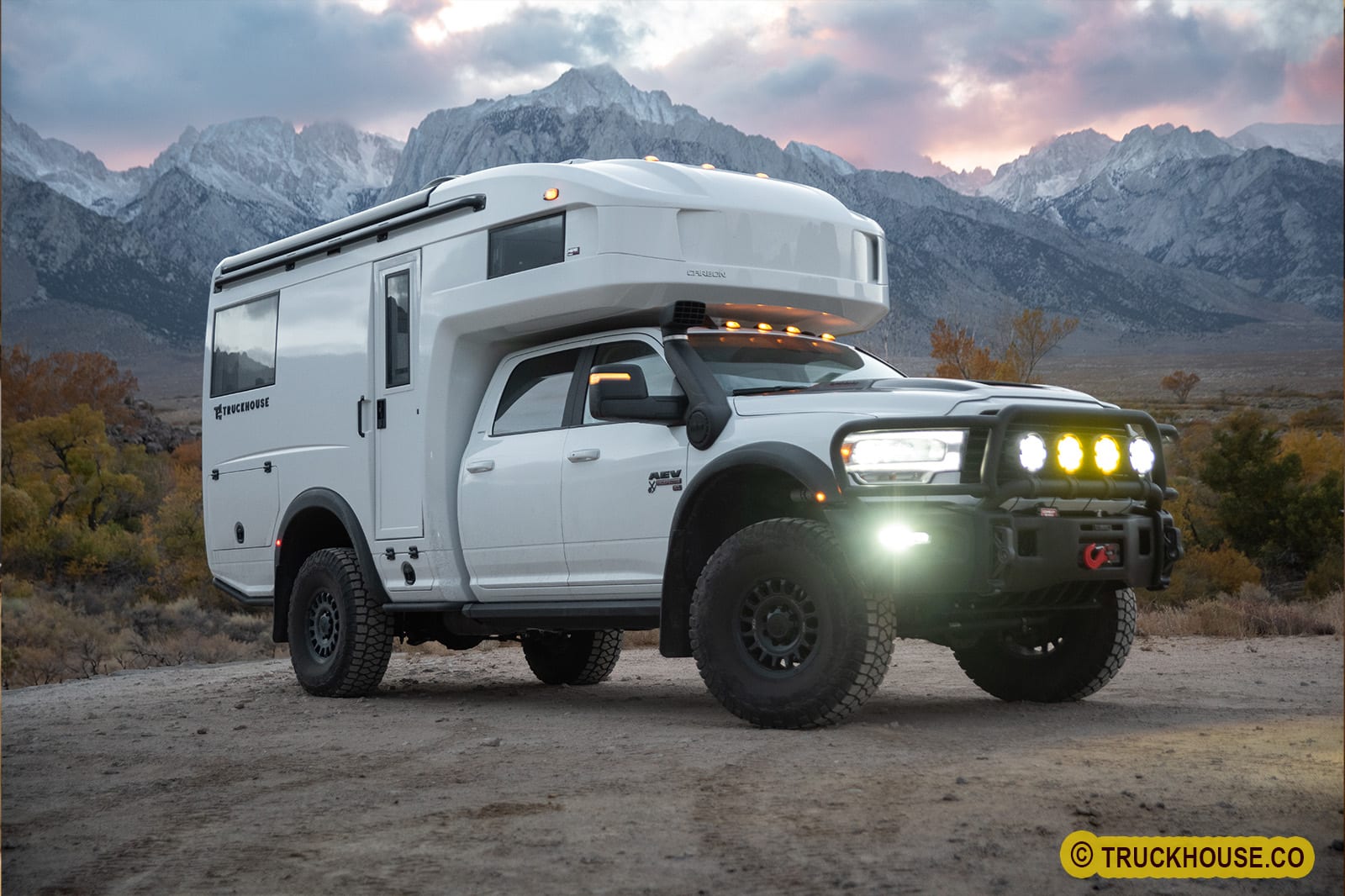
The TruckHouse BCR is a collaboration between TruckHouse and AEV that starts with a Ram 3500 cab chassis and ends up as something that’s generated a lot of attention in the expedition vehicle space. Matt Linder, CEO of TruckHouse, walks through the exterior in detail, and there’s a lot to cover.
The Platform
TruckHouse starts with a Ram 3500 cab chassis and hands it to AEV, who transforms it into what they call the Prospector XL. AEV’s dual sport front suspension isn’t just a lift kit. It’s a fully engineered system that retains Ram’s factory suspension and steering geometry, so it rides better than stock and is fully serviceable at any Ram dealer. Despite being only a 3-inch lift, the geometry changes and AEV’s cross-linked polyethylene roto-molded fender flares allow a 40-inch tire to fit. Part of that clearance comes from pushing the axle slightly forward.
The choice to stay on a 3500 rather than stepping up to a 4500 or 5500 chassis is intentional. A 4500 or 5500 has to go to a commercial Ram dealer for service, and it forces the use of military-spec tires that weigh around 280 pounds each, carry a speed rating of about 68 mph, wear poorly, and are expensive to service. The BCR runs BFG HD Terrain tires developed in collaboration between AEV and BFGoodrich for exactly this kind of vehicle, rated to 99 mph. A set on the demo truck has over 35,000 miles on it and is wearing well.
Front End
The AEV front bumper is stamped steel, not plastic, and not just any steel. It’s galvanil, which is zinc coated, e-coated, and powder coated for a claimed 15-year corrosion protection. It’s stamped in Michigan in a six-story stamp press, which is how you get that kind of geometry out of thick steel. The recovery points are nodular iron, tested and rated to 30,000 lbs.
This particular customer spec’d the AEV bullbar, which houses four AEV 7000 series lights in the center. A Come-Up 20,000 lb winch sits behind the bumper. The truck shown isn’t equipped with the AEV snorkel, but it’s an available option. The snorkel is also roto-molded cross-linked polyethylene, and TruckHouse says they’ve done water crossings up to 36 inches in these vehicles without issue.
The Camper Shell
The camper is a one-piece vacuum-infused carbon fiber monocoque shell, 2 inches nominal thickness. TruckHouse says it’s better insulated than a Yeti cooler, and the construction gives it strength without the weight that would push the build onto a heavier chassis.
The exterior surfacing took thousands of hours to develop. The shell has full tumble home, the same sweeping curve from bottom to top that the Ram cab has. From the front corner to the cab-over, the shell sweeps in about 3 inches per side to match the cab’s taper and reduce frontal area. The cab-over nose curves to match the windshield sweep, and body lines from the hyperfoil pockets carry across the entire length of the shell and tie into the rear window.
The hyperfoils are a TruckHouse patent-pending feature. HYPR stands for high pressure reduction. The leading edge of the camper builds high pressure as the vehicle moves, and the foils channel that air through and manage the drag-induced vortices along the sides. At 65-70 mph, TruckHouse says fuel economy comes in north of 16 mpg. At 85-90 mph, it drops to around 13.
The shell gets a class A automotive paint finish, two-tone on this build to match the AEV-painted truck, with a gold pinstripe carried through both. TruckHouse makes a point about this: if bedliner finishes were the right answer, Ram would sell trucks that way.
Access and Entry
There are no external electric folding stairs. TruckHouse built their own aluminum stairs that fold out from inside the camper on billet hinges. They don’t touch the ground when fully extended, so a perfectly level surface isn’t required. When retracted, you can still enter and exit even if parked next to a high curb or on an off-camber surface. Keeping them inside also keeps them out of mag chloride and road corrosion, and it allows for a full belly skid under the camper, DOM steel and steel plate across the entire underside. The departure end has a separate departure skid with full DOM rub rail. TruckHouse has run demo trucks through Poison Spider and Hell’s Revenge in Moab and dragged all the skids with no damage.
Exterior Storage and Hatches
There are five external storage hatches total, all carbon fiber, built in-house. The hinges are inset, the latches are inset, and the latches are electromagnetic, locking and unlocking with the Ram key fob. No separate keys. The hatches use automotive gasketing, marine grade foam flooring on the interior surfaces, and friction hinges instead of gas struts, so there’s nothing to fail or recalibrate with altitude changes.
One hatch on the driver’s side gives access to the rear fuel fill, a DEF fill, and additional storage. The fuel system is entirely factory Ram, a 52-gallon rear tank and a 22-gallon midship tank for 74 gallons total. All fuel senders, gauges, and distance-to-empty readouts are factory accurate. The DEF tank is around 10 gallons versus the roughly 5-gallon tank in a standard pickup. Combined range is over 1,000 miles, and the full factory warranty is retained.
Another hatch houses the water control panel, laser engraved, with controls for city fill, stream or jerry can fill, fresh tank drain, outdoor shower, and winterization using compressed air from the onboard ARB system, so no antifreeze is needed in the lines.
The gear box runs the full width of the rear and is accessible from both the side hatch and a tailgate-style carbon fiber hatch at the back. The dual access point means if someone parks tight against the rear at a ski resort and the swing outs can’t open, the gear is still reachable from the side. Power is integrated into the gear box, with both 12V and 120V outlets. All interior corners of the storage areas are stainless steel, fabricated in-house, and the latch strike points have stainless steel plates to protect the paint.
Swing Outs and Rear
The swing-out system carries the spare tire on one arm and a storage box on the other. The spare is a 138 lb wheel and tire combo, lowered by a worm-drive winch on the back of the swing arm. The swing outs use forged chromoly hinges, two pivot points per side, and a wrist plate locking design in the center. TruckHouse specifically engineered against the common failure mode of single-pivot swing outs that get into harmonic resonance with the suspension going down the road and eventually crack from the vibration.
The rear bumper is modeled on the AEV Prospector XL rear bumper, shortened for the application, and uses AEV’s roto-molded step treads and nodular iron recovery points to match the front. Three receiver hitches are mounted at the rear: two 2-inch receivers for a custom bike rack and motorcycle carrier, and a 2.5-inch receiver for towing. Tow rating is 10,000 lbs.
Tail lights are JW Speaker, American-made, and recessed into protective surrounds. Marker lights are also JW Speaker.
Awning and Exterior Features
A full integrated awning runs along the passenger side, deploys at the touch of a button, requires no legs, and has a wind sensor that retracts it automatically. The rub rail along the upper edge of the shell sits in its own inset pocket and protects the carbon fiber if the vehicle gets pushed against trees or cliffs on a trail. Windows are dual-pane glass, flush mounted with the apertures designed into the tooling, so there’s no glued-on frame and one fewer potential leak point. There’s one roof window as well.
LEITNER LARA track runs along the driver’s side for modular exterior mounting. TruckHouse says there are about 288 integrated hard points in the shell, engineered with no cold bridge and fully serviceable.
The cassette toilet door is on the driver’s side. TruckHouse offers cassette, dry flush, and composting options. If a customer chooses something other than the cassette, the inset and door are removed and the tooling produces a clean curved surface as if the opening was never there.
Final Thoughts
The BCR is one of the more thoroughly engineered builds in this space, and the AEV foundation gives it a mechanical baseline that most expedition campers don’t have. The 3500 platform decision alone, and everything that follows from it, shows the kind of thinking that went into this thing. Whether the price makes sense depends on what you’re trying to do, but it’s hard to find many corners that were cut.