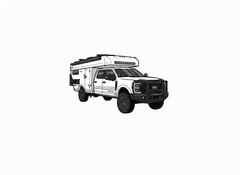
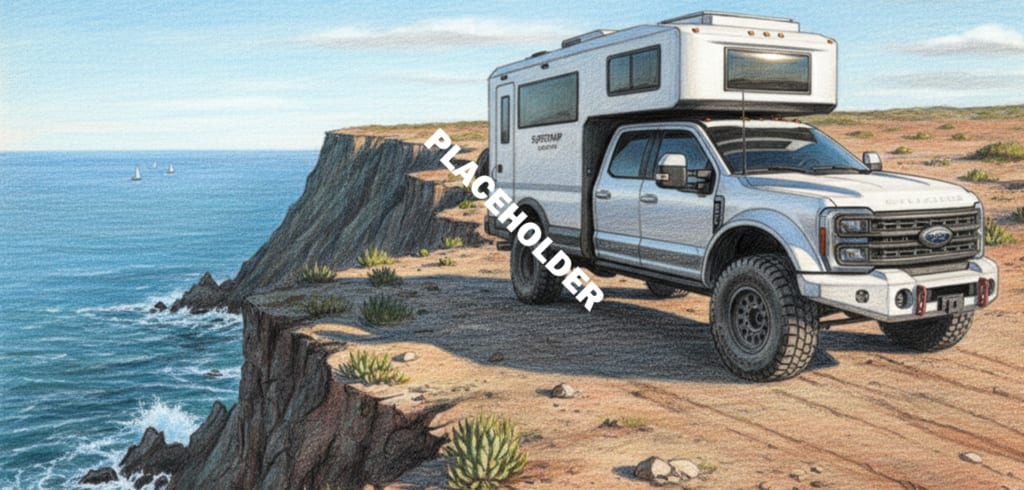
The Megatron is a collaborative truck camper build between Elevation Offgrid and Super Campers, and this is the first client-owned unit off the line. It’s built on a Ford F-550 60CA Black Edition chassis and the result is something that sits in a different category than most truck campers on the market.
Vehicle Platform and Base Specs
The F-550 60CA Black Edition brings 18,500 lbs of towing capacity to the platform, along with what Elevation Offgrid describes as world-class ride comfort, handling, and an insane turning radius. The front and rear track width matches a F-350 DRW, so any commercial Ford dealership with lifts wide enough for a dually can service it. Nothing done by Elevation Offgrid or Super Campers affects the Ford factory warranty, and both companies carry their own warranty that matches Ford’s 3-year, 36,000-mile coverage.
Tires run at 70 PSI in the rear and 65 PSI up front at full load with water on board. Add a trailer and Elevation Offgrid recommends bumping the rears to 75, with 80 as the maximum. For low-speed rock crawling, 25 PSI is the floor they’ll recommend, though they’ve had tires down closer to 15-20 PSI and started hearing sidewalls pop off the bead. Tire rotation is not recommended, and the rears will wear roughly twice as fast as the fronts.
The truck runs dual fuel tanks, front and rear, and the system is automatic. It pulls from the front first and transfers fuel from the rear as needed, balancing itself out rather than burning one tank completely before touching the other. The primary fuel gauge shows a combined reading, but individual tank levels are available in the instrument cluster.
Suspension
The Megatron runs full Liquid Spring suspension, and this is one of the more involved systems on the truck. The driver interface screen controls both ride stiffness and ride height independently. Normal mode is the standard driving position. Sport mode increases valve sensitivity to reduce body roll on twisty roads or in high wind. Height can be adjusted while moving at up to 15 mph, though the recommendation is to return to normal before hitting that speed.
The system raises 8 inches from the low position to high, putting ground clearance at roughly 25 to 26 inches measured from the center of the truck at full height. M-Low drops only the rear while leaving the front at normal height. Low drops both front and rear, which is useful for loading or helping passengers get in and out. High is there for water crossings and rough terrain.
The Liquid Spring system also handles true earth leveling when parked. The interface shows roll and pitch to a finer degree than the factory Ford screen, and hitting the auto button lets it independently modulate each corner up or down until it reads zero. When it’s done, the auto indicator stays solid. Before driving away, the exit button returns the truck to normal ride height. Forgetting to do that won’t damage anything, but the suspension locks about 80% of the fluid to hold the level position, so the truck will feel noticeably wrong until it’s reset.
Exterior and Lighting
Up front, a 16,500 lb winch sits behind a locking access door. The same remote control operates both the front winch and a rear winch used for the spare tire system. The door uses a compression latch with two alignment divots, and the winch itself uses a standard free-spool system, counterclockwise to release and clockwise to re-engage.
Lighting on the front end is organized through auxiliary switches inside the cab. Switch one runs the Baja Designs LP6 forward-facing lamps, which also carry an amber backlight that comes on with the headlights or parking lights. Switch two is the light bar. Switch three operates the corner lights, and those are set up to illuminate the path of the left front tire at full lock, so you can actually see what that tire is about to roll over in the dark. Switch four runs the onboard air compressor.
The air compressor feeds two protected couplers on the exterior. If the switch is hit and the compressor doesn’t turn on, the system is already at pressure. After disconnecting an inflator, holding the base of the coupler up and pulling the hose down bleeds the line. The system does bleed down slowly over about a week of non-use, so some pressure loss between trips is normal.
The rear exterior has a gear storage box and outside kitchen compartment accessed with a single key that operates all the style latches on that side. The kitchen slides out on a tray, lowers an additional four inches, and the recommendation is to drop the truck into low mode at camp to bring the whole vehicle down and make the exterior kitchen easier to work at. There’s a simple burner in the compartment and additional storage alongside it. Up top, aluminum strapping and tie-down points handle firewood or whatever else needs to go up there, and the rear window gives access to that area from inside.
The rear doors swing fully open and pin into place. The outside shower is on this side, with a 3D-printed holder and detent tabs that clip the showerhead back into place when not in use. Hot and cold control is right there on the exterior panel. The electrical box is also back here, with 12V and 110V outlets, USB and USB-C ports, and all the 12V distribution. The 110V outlets are live when the inverter is on, which is marked on the panel.
Power steps are on a sensor system and deploy automatically when the door opens. A step lockout button inside holds them down when needed, and if the steps contact a rock on the way out, they stop automatically.
Electrical
Battery percentage and estimated runtime display on the main control panel inside. The system shows how many days and hours remain based on what’s currently drawing power, and if solar or alternator charging is active, it switches to showing time until full. The camper batteries are separate from the truck’s starting battery, so running the camper systems down doesn’t strand the truck.
The inverter is what puts 110V power to the outlets, the induction cooktop, the microwave, and the speaker system. The recommendation from Elevation Offgrid is to leave the inverter off unless it’s actually needed, since it pulls significant standby power. The Starlink system has its own dedicated power switch on the control panel, so it only runs when needed.
A router inside the camper is always on and provides a local network connection.
Climate
Heating runs on a diesel furnace pulling from the truck’s fuel tank. There’s no propane on this build. Hot water is also diesel-fired, an on-demand system that takes about 20 minutes to warm up from cold and then delivers continuous hot water to the interior sink, the garage, and the exterior shower. The control panel has a dedicated water heater button, and a separate water pump switch pressurizes the lines.
The climate system is split into two zones with independent temperature sensors, one in the main living area and one in the sleeping area. Both the diesel furnace and the air conditioner share the same ductwork, with vents in the bathroom and one in the bed area to the right of the TV. Closing off the lower vents and directing all airflow to the bed vent is the recommended approach for sleeping in warm weather. The control panel runs through low, medium, and high fan speeds, or an auto mode that ramps the fan up or down based on how far the current temperature is from the set point.
For winter camping, the panel includes switches for water tank heaters and battery heaters to keep both systems functional in the cold.
Interior and Living Space
The entry area has storage compartments along both sides, blackout shades on the windows that stop at any position, and a strap-down system for gear that pulls up for easy access. Fuses and breakers are accessible here, along with the exterior light button that illuminates the whole perimeter of the camper. All the exterior lights are dimmable by pressing and holding the button.
The main living area centers on a motorized table that raises and lowers with a button. The cushion from the table seat drops into the lowered table position to create either a couch or additional sleeping space. The induction cooktop is 110V and requires a pot on the surface before it will activate. A microwave is built in, and a K-cup coffee maker is mounted in a fixed position in the cabinetry, so it stays put and you make coffee right there without pulling it out.
The fridge and freezer have a dedicated outlet on the panel. Deep storage runs throughout the cabinetry, and a pass-through area connects to the bed section with a foam pad on the floor to make crawling through easier. Elevation Offgrid recommends keeping that pass-through closed when trying to maintain temperature in either space.
Two TVs are on swivel mounts, one in the main area and one in the bed. Each has a pull-down tab to release the swivel and a small grip to help rotate it. The bed area also has indirect lighting, a dedicated vent from the climate system, and a small storage cubby.
Mood lighting runs through the main control panel with separate buttons for bed lighting, bathroom lighting, main puck lights, exterior strip lights, awning light, and color-changing party lights with a color cycle selector. All interior lights are dimmable.
The awning deploys with a press-and-hold button and can be stopped at any extension. A seismic sensor monitors wind load and retracts the awning automatically if conditions get rough. There’s a dedicated awning strip light that’s also dimmable.
Bathroom
The shower runs off the diesel hot water system with a flow control and a temperature limiter button on the back of the valve head. Pushing that button allows rotation past the default limit for hotter water. A pull-out drip pan keeps the toilet area dry during showers. Soap, shampoo, conditioner, and body wash dispensers are built into the wall with refillable inserts that clip out.
The toilet is a heat-seal bag system rather than a cassette. For liquid waste, dissolvable pouches go in first to coagulate the contents. The flush button holds for about 80 seconds while the bag is heat-sealed, then the bag drops into a sealed lower compartment for retrieval and disposal in a regular trash can. A fresh bag loads over the internal form and the unit reassembles. One bag handles 60 flushes.
The bathroom has a vent fan, an additional climate duct, and a drying line. Closing off all other vents and running heat into the bathroom turns it into a gear drying space.
Final Thoughts
The Megatron is a serious piece of kit, built on a platform that can genuinely tow and go off-road without compromise. The diesel-only fuel system for both heat and hot water is a clean choice, and the Liquid Spring suspension is the kind of thing that’s hard to go back from once you’ve driven it.