
GXV Hilt Comprehensive Walkthrough
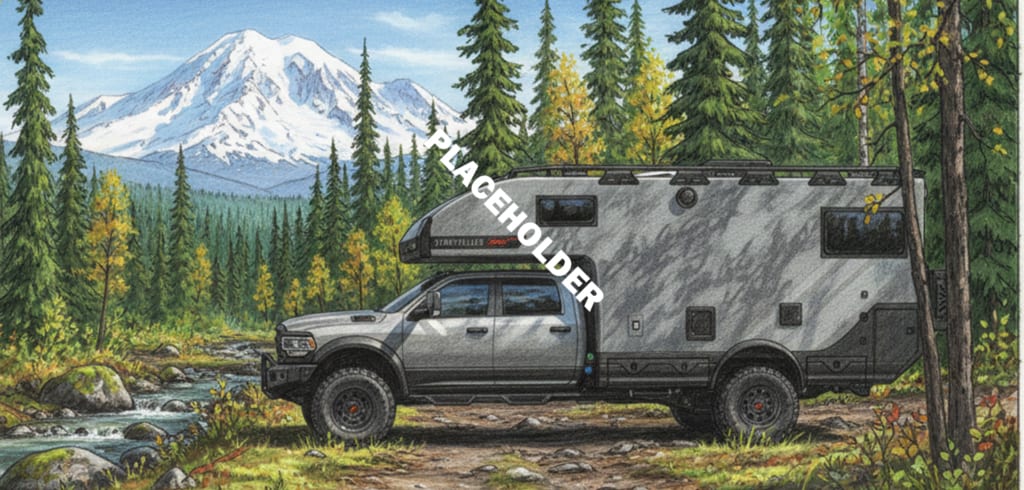
The GXV Hilt is a production expedition vehicle built on a Ram 5500 chassis, and GXV calls it the most capable production vehicle ever built. It’s a big claim, but the specs and the build list make a reasonable case for it.
Vehicle Platform and Base Specs
The Hilt rides on a Ram 5500 Limited, which comes fully loaded from the factory. The chassis has a 197.4-inch wheelbase, and the completed build comes in at 28 feet long, 8 feet wide, and 12 feet 7 inches tall. Add the front accessories and the spare and you’re looking at 29 feet. The gross vehicle weight is 19,500 pounds, split 7,000 up front and 13,500 in the rear, with a gross combined weight rating of 32,000 pounds.
Fuel capacity is 52 gallons, and if the truck is equipped with the optional secondary tank, that adds another 22 gallons. The secondary tank transfers diesel to the front tank and into the engine automatically.
Suspension is Liquid Spring, with three ride comfort settings, sport, normal, and comfort, and six height positions ranging from high down to low. Sport mode stiffens things up for highway driving in crosswinds or on curves. The height adjustment is there for clearing obstacles, tunnels, or low-hanging branches at low speeds, but at normal highway speeds you stay at the normal setting. The wheels are Hutchinson 266s with 41-inch multi-purpose tires on a three-piece bead lock wheel that can run at extreme low PSI without debead. Recommended pressure is 90 PSI rear and 65 PSI front.
Exterior
The entire capsule is coated in a heavy-duty liner to protect against trail damage. Up front is a heavy-duty Flarespace bumper with a winch controlled by a handheld remote, power button, winch in, winch out. The rear carries Vader racks also made by Flarespace, and there are Invader racks on both the driver and passenger sides, highly customizable for whatever gear you want to mount.
There’s a roof rack up top, but GXV advises against mounting anything additional on the roof given the solar panels already up there and the effect extra weight has on the center of gravity.
The entry steps are powered and retractable. They deploy when the doors open and retract when the doors close. There’s a lockout button inside if you’re staying put for a while, and a separate button in the storage area to prevent the steps from deploying when you’re high-centered on an obstacle.
The awning extends to 12 feet 6 inches and has a safety override tied to the ignition. When the engine starts, the awning retracts automatically. To extend it, you arm it from either the entry control module or the galley control module, which keeps it armed for three minutes, then press the out button.
External storage compartments run along the sides with automatic lights that activate when opened. The pass-through storage connects driver to passenger side, and GXV specifically notes not to spray it down with water since there’s nowhere for the water to drain.
On the exterior plumbing side, the fresh water fill is on the exterior wall along with a vent that releases when the tanks are full. The outdoor shower hookup is nearby, connect the hose, make sure the Truma water heater has been running at least 10 minutes, and you’ve got hot and cold pressure water outside. There’s also a 30-amp shore power Smart Plug and a GFI-protected outlet on the passenger side.
Electrical
The Hilt runs an IMP Power energy system that handles the RV side of the electrical load. It’s completely independent of the chassis electrical system and doesn’t touch the engine or chassis accessories. The system runs three voltage levels simultaneously, 12-volt DC, 51-volt DC, and 110-volt AC.
Charging comes from three sources: the 30-amp shore power connection, an auxiliary alternator on the engine, and the solar panels on the roof. Between the alternator charging while driving and the solar topping things off at camp, the system is set up to keep the batteries fed without much intervention.
Control is split across five panels. The mission control display is the main hub, with the main system control module directly below it. The entry control module, dinette control module, cabover control module, and galley control module each handle their respective zones. The mission control display also manages six customizable lighting presets, from a low dim setting meant for sleeping to full perimeter lighting with everything on.
The five auxiliary buttons in the cab control the front bumper spotlights, cab spotlights, side searches, rear spotlights, and the onboard air compressor.
Climate
The climate system runs Magic Climate, which automatically switches between AC and heat as needed. Two exhaust fans can be run automatically or manually, and the AC distribution is fully adjustable, both the slide vents on the unit itself and eight individual ports that can be pointed in any direction.
Heating runs off vehicle fuel through a small furnace that heats both cabin air and water via a heat exchanger. There’s also an electric auxiliary heating system, and in cold weather the system can help keep the plumbing from freezing.
Interior Layout and Living Space
The interior is 6 feet 7 inches tall and 6 feet 11 inches wide. A pass-through connects the capsule directly to the truck cab, with the seats folded down and everything padded for comfort.
The dining area doubles as sleeping space. The table removes and stows away, and the seating converts into a bed. There’s also a ladder that lifts and hooks to allow access to the cabover loft. Both the front and rear beds are queen-sized, so the Hilt sleeps four comfortably. The loft area has storage compartments and charging ports for phones and other devices.
Storage runs throughout. Overhead compartments above the dining area handle clothes, food, and gear. A closet behind the dining area has two foldable shelves and a coat rack for anything that needs to hang. The breaker panel sits underneath the closet.
The windows have blackout shades and bug screens, and they can be popped open by pressing the center button to extend them. A skylight in the cabover opens for stargazing.
Galley
The sink is a deep basin with two separate taps, regular tap water on the right and purified water on the left. Next to it is an 1,800-watt dual induction stove that’s removable if you want to cook outside. The microwave above is a 4-in-1 unit handling microwave, air fryer, convection oven, and dehydrator functions. Below the stove there’s a fridge-freezer combo, refrigerator on top and freezer on the bottom.
A pop-up outlet on the countertop has USB ports on one side, a standard outlet on the other, and induction charging on top. Drawers and cabinets below the stove provide additional storage, and there’s a dedicated spot for the trash can and a smaller compartment for paperwork or loose items.
Bathroom
The shower is a dedicated compartment with a power button for the lights, controls for the sink on the left wall and the shower on the right. The showerhead is mounted on a pole that slides up, down, and side to side. A pull-out line above serves as a towel bar. There’s an exhaust fan in the ceiling, push to open, button to run, press again to shut it down and pull it back in.
The toilet is a cassette unit that rotates slightly for more room when needed. The flush is on the left side. The cassette holds 4.75 gallons and removes through an exterior access door by pressing two buttons and pulling a blue lever on the underside of the cassette. It dumps at any waste station.
Fresh water capacity is 120 gallons and gray water is 45 gallons.
Final Thoughts
The Hilt is a serious piece of kit, built for people who want to go far and stay out long without giving up much in the way of comfort. The spec list is dense and the feature count is high, but nothing on it feels like it’s there just to fill a brochure.