
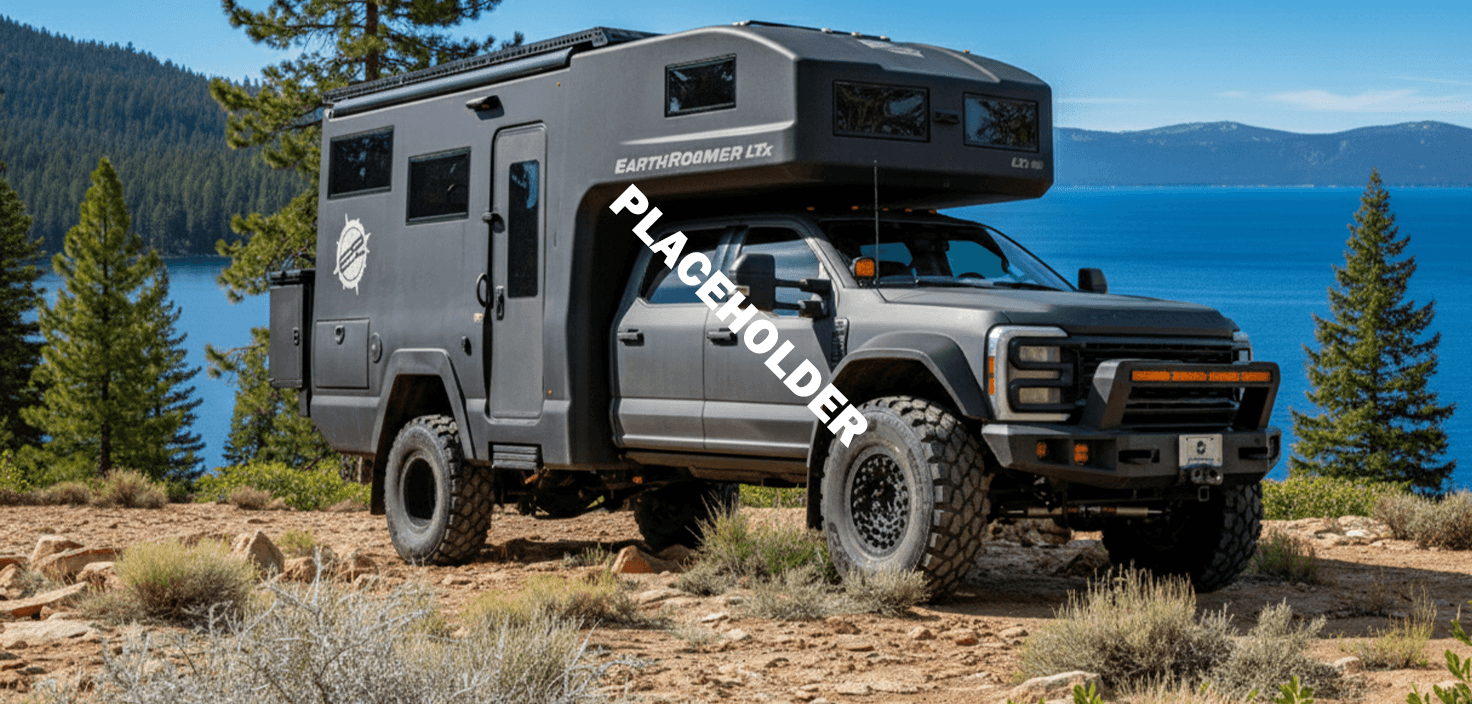
EarthRoamer LTx: Full Exterior and Interior Tour
EarthRoamer has been building expedition vehicles on the Ford F550 for over 27 years, and the LTx is their latest iteration of the LT line. It carries forward the same basic formula but with significant upgrades to the electrical system, shell design, and interior layout.
Vehicle Platform and Base Specs
The LTx starts as a Ford F550 with a 6.7L Power Stroke turbo diesel and a 10-speed automatic transmission. EarthRoamer orders these trucks in the Lariat trim, so the cab comes with Ford’s higher-end fit and finish from the factory. From there, the modifications are extensive enough that the end result doesn’t feel like an upfitted truck so much as something that was designed as a single integrated machine.
Tires are 43 inches and rated for highway speeds up to 75 mph, wrapped around Hutchinson three-piece wheels. Those wheels function as a double bead lock, so airing down for sand or soft terrain isn’t a concern. Suspension is four-corner independent air ride with custom-valved Fox shocks, giving adjustable ride height and the ability to level the truck at camp by controlling each corner independently. That controller also works from a phone, so someone in the back of the camper can dial in the leveling without going forward to the cab.
The running boards are automatic, extending whenever a door opens. On the roof, the solar panels are fully walkable.
Exterior
The front bumper is custom all-aluminum and packed with Baja Designs lighting. There’s a Warn 16,500 lb winch up front with a synthetic line and a Factor 55 flat link, and a matching 16,500 lb Warn winch on the rear bumper. A FLIR forward-looking infrared camera is integrated into the front bumper alongside a parking camera. A rooftop camera gives an overhead view of oncoming terrain, and the rearview mirror displays a continuous rear feed as well. Multiple camera angles can be pulled up on the main dash screen and toggled with the upfitter switches.
The shell is a one-piece carbon fiber monocoque structure, fully insulated, coated in EarthRoamer’s in-house Xguard finish. Xguard can be done in any color and cleans up with a power washer after tight trail work. The windows are dual-pane frameless stained glass rather than tinted glass, running along all sides of the camper.
The entry door is 26 inches wide, the widest EarthRoamer has offered, with an integrated bug screen and automatic steps. Just inside the door are controls for the awning and the exterior LEDs, which run on three sides of the vehicle. To the left of the door is a 120V AC exterior outlet pulling from the camper’s battery bank.
At the rear, the pass-through storage garage spans the full width of the camper and is heated, so gear stays accessible through winter. Slide-out trays are available as an option. The garage also holds an axe, shovel, stepladder, bottle jack, and an exterior shower with hot and cold pressurized water. There are 120V AC outlets inside the garage for charging gear like e-bike batteries on the road.
The rear storage box has been redesigned so the door opens from the side rather than swinging out. Inside, there’s room for a Traeger smoker, propane grill, Blackstone griddle, or pizza oven depending on what the customer wants. Above that is storage for grilling accessories or firewood, and a slide-out table mounts above the door. A MOLLE panel on the back of the box accepts bike racks, which in the current configuration hold up to four bikes vertically, or a waterproof storage box for those who don’t need the bike setup.
The roof rack uses mounts bonded into the composite structure, reducing roof penetrations by over 80% compared to previous designs. It’s modular, so the configuration can be changed as technology changes. Starlink is mounted on the roof.
Diesel exhaust fluid fills lower on the LTx than on previous models. Diesel tanks total 95 gallons, accessed through two doors on the driver’s side, giving just over 1,000 miles of range. The cassette toilet empties from an access door on the driver’s side as well, with a 5-gallon removable cartridge.
Electrical
The LTx runs on a new 24-volt system, which EarthRoamer says delivers 40% better air conditioning efficiency compared to previous models, with gains across other systems as well. The battery bank is 18,000 Wh of lithium-ion. Solar is 1,480 watts on the roof. Dual alternators charge the batteries while driving or idling. There are 9,000 watts of inverters on board. Shore power is a 30-amp connection on the driver’s side, though EarthRoamer notes it’s rarely needed given the solar and alternator setup.
The CZone screen inside the camper is the central control panel for monitoring battery state, solar input, water levels, temperatures, and controlling lights, water pumps, air conditioning, awning, and door locks. All locks, including the cab, camper door, garage, and exterior boxes, are integrated and work from either the key fob or CZone. The system also supports remote engine start and an auto-charge mode that monitors battery levels and automatically starts the truck to run the alternators if charge drops too low, including overnight without waking anyone.
Climate
Heating and hot water both run off diesel appliances pulling from the same 95-gallon tanks as the truck engine, so there’s no separate propane supply to manage. EarthRoamer calls this setup capable of keeping the vehicle warm and comfortable deep into winter. Frost protection systems are built in for four-season use, and a winterization procedure accessible through the CZone screen uses the onboard air compressor to blow out all lines for long-term cold storage.
Cab
The cab interior has the standard Lariat appointments from Ford, and EarthRoamer integrates their camera system into the factory infotainment screen. Upfitter switches handle camera toggling and standard off-road lighting. A Switch-Pros panel is available for customers who add auxiliary lights near the windshield. All off-road lights pair with the factory high beams, so a full lighting scene can be set up and triggered with a single high-beam click.
Transfer case options include two-wheel drive high, four-wheel drive high, four-wheel drive low, and a two-wheel drive low mode that EarthRoamer adds. That last mode gives the low-range gearing and torque of 4WD low while freeing up steering for tight switchbacks where four-wheel drive bind is a problem.
A GMRS radio is mounted next to the center console, a built-in 50-watt unit for group trail communication. The air ride suspension controller sits by the right knee and also connects to the phone app. A pass-through opening in the rear cab wall connects to the camper, with insulated barn doors that lock. Rear seating options include dual captain’s chairs, a fold-down jump seat for a fifth passenger, or flat dog platforms with storage underneath.
Galley
The galley countertop is also the induction cooktop, with the induction surface built directly into the counter material. Cookware goes right on the surface, and because the heat generates in the pan rather than the surface, the counter itself doesn’t get as hot. Silicone pads are included. A pull-out extension adds more counter space on the side and sits flush with the main counter when deployed.
Below the induction counter is a microwave, convection oven, and broiler combo, positioned lower than on previous models for easier access. An oversized drawer below that holds cookware. The undermounted stainless steel sink has a full household faucet, a soap dispenser, and a separate drinking water faucet. Water filtration runs three stages: sediment, carbon, and UV, filtering all 100 gallons of fresh water on board. Sink accessories including a cutting board and drying rack store under the sink along with the trash can and filter access.
The upper galley has two cabinets. One is open storage. The other can be fitted with an optional dish management system with foam-protected plates, bowls, and glasses. Silverware and Japanese knives are in dedicated drawers below, the knives secured with magnets.
Opposite the sink is a 10-cubic-foot fridge-freezer. There’s a fridge compartment on top and two individually controlled drawers below that can each be set as fridge or freezer depending on the trip. A wine rack next to the fridge holds five bottles and all the glasses, with wine tools in a drawer underneath. Below that is the coffee maker, in this case a Keurig, and below that is the pantry.
Dinette and Living Area
The L-shaped dinette at the rear seats four and has three configurations. Leaves fold out for a full dining table, the table drops and leaves fold in for a coffee table orientation with a cushioned surface more suited to lounging, or the table drops all the way down to create a full-size bed. The table also slides in multiple directions to get the positioning right for each use. A touch panel on the side of the dinette controls the water pump, dinette lighting, and a 42-inch TV that comes up from the cabinet.
The rear of the camper has 270-degree glass windows. All of those windows are dual-pane with bug screens and shades built in.
Bathroom
The wet bath has been redesigned with a slate back wall and teak accents throughout. There’s a teak bench for showering, and the cassette toilet is accessed below it. The vanity is repositioned against the wall, which opens up more floor space than previous wet bath layouts and adds countertop space for toiletries. Storage is in a medicine cabinet at eye level and under the sink. A vent fan is in the ceiling. Standing height in the wet bath is 6 feet 10 inches.
Sleeping
The bunk above the cab is a California king. Storage runs underneath the mattress and on both sides of the bed, with wireless chargers and USB ports on each side. A control panel at the front of the bunk connects to the CZone system, so door locks, lights, and other systems can be managed without climbing back down. The steps up to the bunk are wider than on previous models, and there’s also a step cut into the side of the adjacent cabinet with a ceiling grab handle as a faster entry option.
Final Thoughts
The LTx is a significant step up from previous LT models in terms of electrical capacity and interior finish, and the 24-volt system and 18,000 Wh battery bank give it a legitimate claim to full off-grid self-sufficiency. Every system on this truck is designed to work together, and the level of integration between cab and camper is something most expedition builds don’t come close to matching.