
Introduction
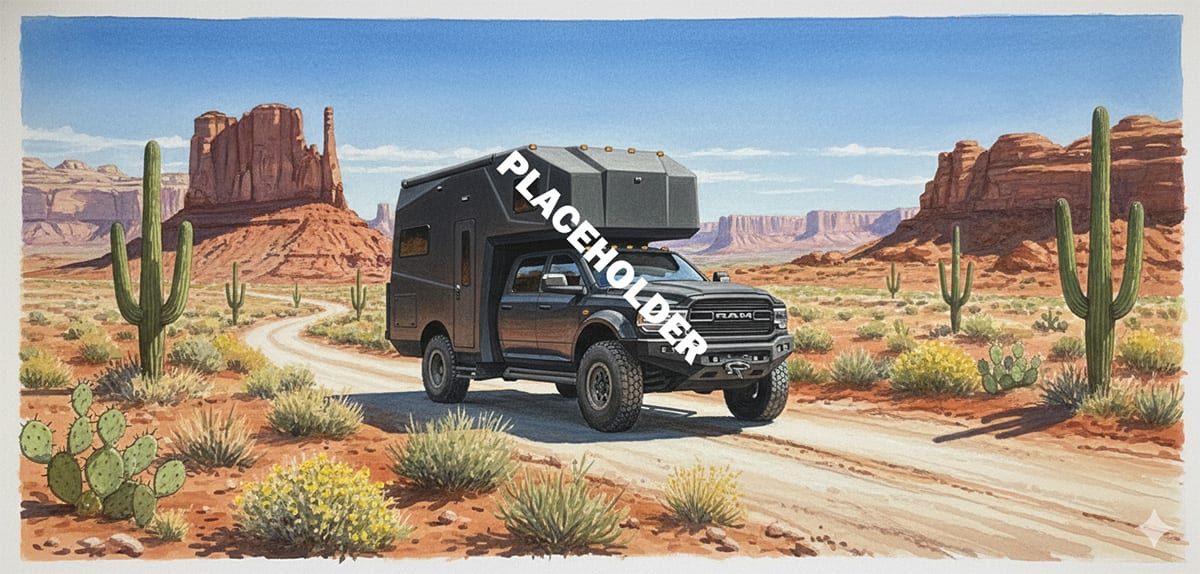
The TR27 is a truck camper built by 27North on a Ram 5500 chassis, and it’s designed from the ground up to outlast just about everything else on the market. No wood framing, no organic materials anywhere in the structure, and a one-piece vacuum-infused carbon fiber shell. Pavle, the CEO and founder of 27North, has said that his first RV felt like a cardboard box on wheels, and the TR27 is the direct answer to that.
The Builder
27North’s entire design philosophy comes down to building for three generations instead of four years. That’s a direct shot at an industry where, according to Pavle, some leaders have openly admitted they’re building RVs to last four years, even while customers finance them over twenty. The TR27 is what happens when someone decides to build the opposite of that.
Vehicle Platform and Base Specs
The prototype TR27 sits on a Ram 5500, the shortest wheelbase 5500 available. The unit weighs around 14,000 lbs total, which is lighter than a lot of comparable rigs. The liquid spring suspension gives 12 inches of variable ride height and includes true earth auto-leveling. There’s an adjustment panel inside the cab where you can control ride height, auto-leveling, and ride comfort level. Running boards are standard because even at normal ride height, this thing is tall, with the hood sitting around 5.5 feet off the ground.
The prototype is wearing mud and snow rated tires that Pavle himself called terrible, and it shows in the ride. He’s said the ride would be noticeably better with a different tire choice. The 40-inch tires on the unit do handle snow, but they’re not doing the suspension any favors. The liquid springs, though, are doing a lot of the heavy lifting and the handling is surprisingly composed for something this size.
Exterior Shell and Construction
The outer shell is a single one-piece molded carbon fiber shell, vacuum infused, with no seams holding the edges together. On top of that is adventure skin, a thick protective wrap that covers the shell, the door jambs, the A, B, and C pillars, and even goes over the badges. 27North takes the doors completely apart to apply it inside and out. The result is a surface that shrugs off sticks, rocks, and hail, and you can stand on the roof without worrying about it.
The wall construction goes from outside in: adventure skin, carbon fiber, super high-density foam, 3M Thinsulate, another layer of carbon fiber, more Thinsulate, and then the interior aluminum panels. That whole assembly weighs around 660 lbs before anything is loaded in. The aerodynamic lines molded into the shell help break up wind resistance so the unit doesn’t act like a sail, and there’s a rear spoiler that keeps the spare tire and rear window clean by managing the vortex off the back.
27North worked with Stellantis to match the front cap dimensions to the Ram’s proportions so the whole thing looks close to OEM from the front. The front bumper includes pod lights, a Warn winch, a skid plate, and a push hitch. Ditch lights are mounted up top and are adjustable for angle and direction.
Interior Construction
Every surface inside is aluminum. The floor, the walls, the roof panels, and the cabinetry are all aluminum framing with no wood and no organic materials anywhere. The floor is layered with super high-density foam that won’t crush or change shape over time, topped with marine-grade rubber. Cabinets are built off-site as separate units and then brought in and secured, rather than being assembled in place, and that shows in how tight everything feels while driving.
The cabinets use robust latches that don’t rattle open on the road. The mounting system uses 3M double-sided tape around all mounting points before screwing things down, which combined with the pre-built cabinet approach results in very few rattles or shakes. Kilmat sound deadening is added at the pass-through to the cab and in several other locations, and the result is a noticeably quiet interior. The loudest thing on the road is tire noise.
The windows throughout are dual-pane acrylic, opening awning style and holding whatever position you set them. They have bug screens and blackout shades that act as a second thermal barrier. There’s a skylight in the same style above the bed area.
Kitchen
The kitchen runs along one side of the unit. There’s a deep sink with a pull-out faucet, a wooden cover that drops over it, and a small drying rack below. The countertops are Plyoo, and a pull-out Plyoo extension panel is where the induction cooktop lives when it’s in use and stows away when it’s not. A microwave is mounted overhead. A pop-up power brick on the counter has USB-C, USB-A, and two AC outlets. Aluminum pegboards are mounted for hanging whatever you want. Three drawers plus the induction cooktop drawer, and a full run of overhead cabinets with a lot of usable space for a rig that’s under 26 feet long. Tank level monitors and the water pump switch are tucked in near the counter as well.
Fresh water capacity is 100 gallons across two heated tanks. Both tanks stayed unfrozen overnight at minus 25 degrees Fahrenheit.
Bathroom
The bathroom has all-aluminum walls and the same mirror-finish aluminum ceiling panels that run throughout the rest of the unit. There’s a window, a shower head that comes off the sink, a cassette toilet, and a textured shower pan. The space is genuinely roomy enough to move around in. A MaxAir fan is in the bathroom ceiling in addition to the one in the main living area.
The cassette toilet pulls out through an insulated exterior panel. It has wheels, so you can roll it to wherever you’re dumping it.
Sleeping and Living Area
The dinette uses two adjustable Lagoon tables at the back of the unit, and the real leather cushions have wood backers so they fit together flat across the middle to form a queen-size bed. The prototype’s leather is a deep brown that the reviewer compared to BMW’s Tartufo Brown. A TV is mounted on the wall nearby.
Up front near the cab, the bed is king-size with a leather headboard. There are windows on all sides, outlets and cup holders on both sides of the bed, and a second TV mounted at the foot of the sleeping area. The heat and cold air from the 48V air conditioner collect up in the sleeping area, which keeps it comfortable through the night.
Dimmable LED puck-style overhead lights and dimmable under-cabinet lights are controlled from a panel near the entry door.
Electrical System
Power comes from an EcoFlow system with 930 amp hours of battery storage across three batteries, each 310 amp hours, with individual heating packs. The inverter is 3,000 watts. Inputs include a 350-watt rooftop solar panel, direct chassis charging that kicks in automatically when the batteries drop to a set percentage, and a 30-amp smart plug hookup that pushes around 2.5 kW. That’s a lot of ways to keep the batteries topped off, and running them down would take some doing. All outputs are manageable through the EcoFlow panel, where you can name them individually and monitor the 48V circuits for the air conditioner and the spare winch separately from the rest. Battery heating is switchable from the same panel.
Outlets throughout the interior are wired with residential electrical wiring and would meet residential electrical code. There are standard household outlets with USB-C and USB-A at multiple points in the living area and sleeping area.
The 360-degree Ghost security camera system is standard. You can monitor it from a phone, or optionally have a dedicated screen built into one of the cabinets.
Climate
The Truma Combi diesel/electric heating system sits under the fridge. Running on diesel overnight at around minus 15 degrees Fahrenheit used only about 10 to 15 miles of equivalent range. The system pumps out a lot of heat fast. Truma vents run to both the upper and lower sections of the living area, and the Truma control panel is mounted near the entry side of the cab pass-through.
The 48V air conditioner has been tested at over 120 degrees Fahrenheit and kept the interior cool. A lot of that comes down to the multi-layer insulated shell, which keeps heat or cold from getting in or out.
Exterior Storage and Utility
The rear storage compartment doors are cut directly out of the shell and are insulated as a result. Hydraulic struts hold them open. Inside there’s a hot and cold outdoor shower, a GFCI outlet, a service panel, and access to the plumbing and one of the three EcoFlow batteries. The gray tank drain and DEF fill are accessible from the exterior, and the dump valves are electronically actuated rather than manual pull valves. A separate compartment on the other side houses the EcoFlow inverter, power management system, additional batteries, the automatic drain switches, and a fire extinguisher.
The rear bumper carries a spare tire on a motorized drop mechanism so you don’t have to hold up the weight manually. A rear rack can mount extra fuel cans, water, or bikes, and 27North sells bike rack options directly. The diesel fill is relocated to the exterior. Parking sensors are carried over into the aftermarket bumper. A Fiamma electric awning is mounted at the rear, and there’s a solar input port on the side for adding portable solar panels.
The Custom Blue TR27
A second unit was on-site, a customer build in blue with a Laramie cab rather than the prototype’s Limited trim. The interior on this one is walnut throughout, with glass-front upper cabinets, soft-close doors, and solid surface countertops. The sink is larger with a tucked-away faucet and a perforated cover for drying. A cup washer is built into the counter. The fridge and freezer are separate units, and this is the fridge configuration that will be standard on production TR27s. The shower in this build is tiled and will have a glass door. An LED strip runs the ceiling instead of the puck lights from the prototype. Wet Sounds speakers are mounted outside and in, with additional speakers under the cabinets and in the bed area, plus a subwoofer controlled from a Wet Sounds panel.
The walnut build is what a customer-specified interior looks like when someone asks for TR27 capability with a higher-end finish, and the fit and finish on the cabinetry shows the difference between a prototype and a production unit clearly.
Final Thoughts
The TR27 was driven in 8 to 10 inches of snow at minus 20 degrees wind chill and the occupant got too hot overnight. That’s a pretty good proof of concept for a rig that’s still in early production. It’s heavy enough to take seriously and light enough to handle better than it has any right to.